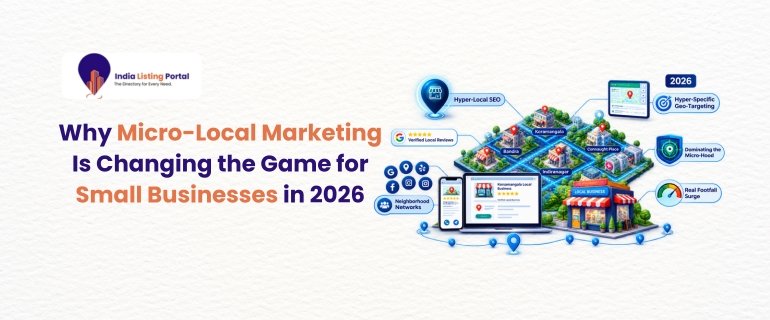
What Micro-Local Marketing Really Means for Small Businesses?
Micro-local marketing is the process of marketing to a very small target market, for example, in one neighbourhood, one housing society, one market lane or a couple of city blocks. Rather than trying to reach a whole city, you focus on customers who can get to your shop in minutes.
For years, small-business marketing emulated the big-brand approach and spent money for reach. In 2026, that approach feels costly and unfocused. People today search for terms like "near me" and expect prompt answers from companies that understand their street.
This guide covers why this shift matters, how it differs from older tactics, and what small business owners can do this month.
Key Takeaways
-
Micro-local marketing can focus on a neighborhood instead of an entire city, reducing the cost of acquiring a customer.
-
A well-written listing, positive local reviews, and community relationships matter more than an ad budget.
-
By looking at the results by area, you can see where to invest your time and money.
Why Local Marketing for Small Businesses Is Getting Smaller?
Search engines and map apps have gotten better at matching up people with their local businesses. If someone is looking for a bakery, a tutor, or a plumber, proximity and relevance determine who shows up first.
That works in favour of local marketing for small businesses. A city-wide search might be a more congested environment for big brands, while a neighbourhood search may be more open. Your closest competitor may not have updated their listing in months.
Budgets matter too. The smaller the ad budget, the more it reaches relevant customers than the same budget spread across a metro area.
Lastly, trust builds faster when you stay local. Shoppers trust the neighbour more than a national slogan, and micro-local marketing builds on that.
Hyperlocal Marketing vs Micro-Local Marketing: Key Differences
Hyperlocal marketing already targets a small area, typically a suburb or locality. Micro-local marketing goes one step further. It tailors the message, offer, and timing to the habits of one tight community.
Let's make a quick comparison:
|
Approach |
Target Area |
Example |
|
Traditional local marketing |
Whole city or district |
A general "best salon in the city" ad |
|
Hyperlocal marketing |
One locality or suburb |
A page for "salon in Andheri West" |
|
Micro-local marketing |
A few streets or one society |
A weekday offer for residents of one housing complex |
Consider it as zooming in on a map. Each level provides deeper insight into your customer.
Practical Micro-Local Marketing Tactics You Can Start Today
You don't need a large staff to start out your small business marketing this way. The following 5 steps apply to most shops and service providers.
-
Polish your Google Business Profile. Select the right categories, upload new photos, and update it weekly. Google's Business Profile Help explains each field.
-
Write for your neighbourhood. Use local landmarks, local events, and common area issues in your content to show a real connection to your community.
-
Team up with neighbours. Cafes, gyms, coaching centres, and resident associations can share offers with their customers.
-
Encourage area-specific reviews. Customers who reference the locality in a review are helping you rank for that exact locality.
-
Use WhatsApp Business. A catalogue and broadcast list can keep local customers updated without additional ad spend.
Use one or two tactics, observe the reaction, and add more if they work.
Digital Marketing for Small Businesses: Tools That Support Micro-Local Reach
Digital marketing for small businesses doesn't have to be a costly stack. A few well-chosen tools cover most needs.
Consistent listings. Search engines validate your name, address, and telephone number on the Internet. If you're listed in a trusted directory like India Listing Portal, you can ensure those details are consistent. The India Listing Portal blog also has several more local visibility guides.
Geo-targeted ads. Choose a small radius around where you live and advertise only during your busiest time.
Simple tracking. Add UTM tags to your links and use call tracking, so you can see which area or channel brought each enquiry. If you need more insight, consider Think with Google's consumer-behaviour research.
Data by area shows where to spend more and pull back.
Mistakes That Hold Back Small Business Marketing
Even a well-meaning owner will make mistakes. Watch for these:
-
Inconsistent details. Two phone numbers across two directories confuse both customers and search engines.
-
Copy-paste location pages. Changing only the area name adds no value. Write something helpful for each location.
-
Ignoring reviews. Reply to every review, good or bad, within a couple of days.
-
Targeting too widely. As soon as your message could be anywhere, it will feel nowhere.
Conclusion
Micro-local marketing reflects how people search, shop, and buy in 2026: close to home, fast, and trusted. We looked at how it differs from hyperlocal marketing, which tactics to try, and which tools and mistakes deserve your attention. For small-business local marketing, the best plan is simple. Start small, stay consistent, measure by location, and grow only when you see a response in your neighbourhood.
FAQs
Q1. How much should a small business spend on micro-local marketing?
There is no fixed figure. Digital marketing for small businesses often starts with free steps, such as optimising their Google Business Profile and collecting reviews, then adds a small geo-targeted ad budget once they see results.
Q2. How long does micro-local marketing take to show results?
Ads and offers can bring enquiries within days, while listings, reviews, and local content usually take a few weeks to build visibility. Consistency matters more than speed.
Q3. Can an online-only business use micro-local marketing?
Yes. Online brands can target specific cities or areas with local landing pages, delivery zones, and pop-up events, even without a physical shop.
Want help attracting customers in your neighbourhood? Get in touch: https://indialistingportal.com/contact | support@indialistingportal.com