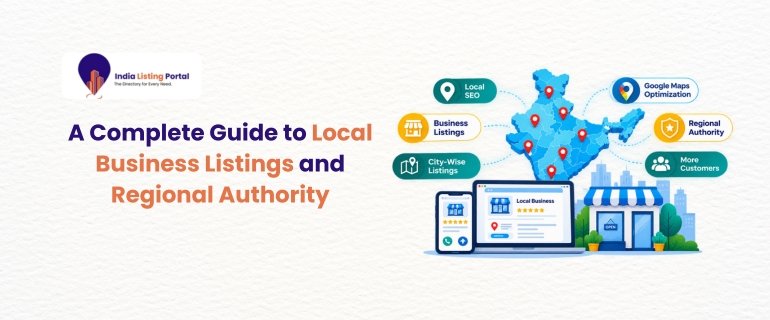
What Are Local Business Listings, and Why Do They Matter?
Whether you realized it or not, even if you are a shop, a clinic, a service business, or any kind of company that has a physical location, you already have a customer searching for you online today. Local Business Listings are the pieces of information about your business that are visible on search engines, maps, and business directories. They're usually the first impression that any potential customer has of your business before they ever come through your door, and each one typically contains your business name, address, phone number, website, hours, and category.
The full picture creates Regional Authority: the trust and visibility a business earns within a geographic area, city, state, or service area. If your listings are uniform and consistently spaced out, it tells the search engines that you're a real and established business, and not simply a one-off or unverified listing. In this guide, you'll learn how listings and directories contribute to that authority, why they're still relevant to local search, and how you can boost your own local authority.
Key Takeaways
-
Local Business Listings are the foundation of how search engines and customers verify a business's location and legitimacy
-
Regional Authority increases when the data is consistent across platforms.
-
Online directories are still one of the best resources to gain backlinks and local visibility.
-
Accuracy, completeness and category choice matter more than listing volume.
-
A mix of general and industry-specific business directories works better than relying on one platform
How Online Directories Build Regional Authority?
Search engines can't actually visit a business at a specific address. Rather, they cross-reference signals from various sources such as online directories, government registers, review platforms, and the business's website. They recognize that trust is gained by repetition when the same name, address, and phone number are displayed repeatedly on several trusted directories and search engines, which is how Regional Authority got its name. It's not built on one perfect listing, but on a series of matched, verified information distributed across a diverse, healthy mix of platforms.
Recent research also shows how much weight consumers place on this information. A brightLocal 2026 consumer survey reveals that 80% of shoppers research a business online before visiting or purchasing from them, meaning that a lack of or incomplete listing can be a costly strategy for businesses before customers reach out.
Why Local SEO Still Depends on Business Directories?
Many business owners believe directories are no longer relevant since Google Business Profile became the go-to place for local searches. In practice, local SEO still leans on directories for a few reasons:
-
Citation consistency: consistent NAP information across directories builds trust in your main listing with search engines.
-
Referral traffic: an optimized profile can send direct clicks from people browsing that platform
-
Category-specific discovery: niche directories put you in front of buyers already filtering for what you offer
-
Backlink value: most directories link back to your website, adding relevant links to your SEO profile
-
Redundancy: if your Google Business Profile is ever suspended, listings keep you discoverable elsewhere
As AI-generated answers pull from a wider set of sources to describe local businesses, accurate information spread across multiple online directories also makes it more likely that any one source gets cited correctly.
Local Business Listings vs. Website-Only SEO
Business owners sometimes ask whether a strong website is enough on its own. It usually is not:
|
Factor |
Local Business Listings |
Website-Only SEO |
|
Trust signal source |
Multiple third-party platforms |
Self-reported, single source |
|
Discovery surface |
Search results, maps, directory search |
Primarily organic search |
|
Setup effort |
Moderate, spread across platforms |
Concentrated on one site |
|
Regional Authority impact |
Direct and cumulative |
Indirect, slower to build |
|
Resilience |
Distributed across sources |
Dependent on one property |
The best strategies combine a website and local business listings for depth, breadth and trust.
How to Optimize Your Business Listings for Regional Authority?
Getting listed is just the first step. These practices distinguish between a listing that helps and one that goes unnoticed:
-
Ensure that NAP is consistent across all locations; using "St." versus "Street" where appropriate helps send a trust signal
-
Select the primary category that is most accurate rather than a number of loosely-related categories.
-
Complete all of these fields: description, hours, service areas, photos
-
Use real, current photographs, NOT stock photographs.
-
Encourage and respond to reviews, one of the strongest ongoing trust signals
-
Prioritize industry and regional directories over large, unrelated platforms
-
Audit listings periodically, since business details change more often than every directory gets updated
Our guide on how Local Business Listings improve local SEO rankings covers the ranking mechanics in more detail, and 7 business listing optimization strategies breaks down profile-level tactics you can apply directly.
Common Mistakes That Undermine Regional Authority
Even well-meaning companies make a few common mistakes that hurt their cause: duplicate listings with slightly different names, categories that no longer match the business, after-move listings, and relying on a single directory. All of these chip away at the stability Regional Authority relies on. Our breakdown of common business listing mistakes covers these in more depth.
Conclusion
Local Business Listings and Regional Authority are closely connected. Listings provide verifiable data that search engines use to determine whether a business is located in a specific area and whether it is trustworthy. Regional Authority measures that trust. Business directories remain a practical, low-cost way to build it, as long as the information stays accurate and consistent everywhere. It's not about getting as many listings as possible. It's about ensuring the ones that are there are accurate, complete, and truly representative of the business as it is today.
FAQs
Q1. How many business directories should a local business be listed on?
There's no fixed number. A good start is two or three important directories, plus two or three for your industry or region. Listing consistency matters more than the number of listings.
Q2. Do free business directories still help local SEO?
Yes, especially if they are well moderated and relevant to your industry or geographic location. It's not about how much a listing costs or whether it's paid or free; it's about accurate and consistent citation information.
Q3. How long does it take for a new business listing to affect rankings?
Movement is usually slow, taking several weeks to a few months, as search engines crawl and cross-reference the new information with existing signals. This typically speeds up with consistent information across listings.
Building Regional Authority starts with a single accurate, complete listing. Add your business to India Listing Portal, or reach out at support@indialistingportal.com with any questions about optimizing your existing profile.