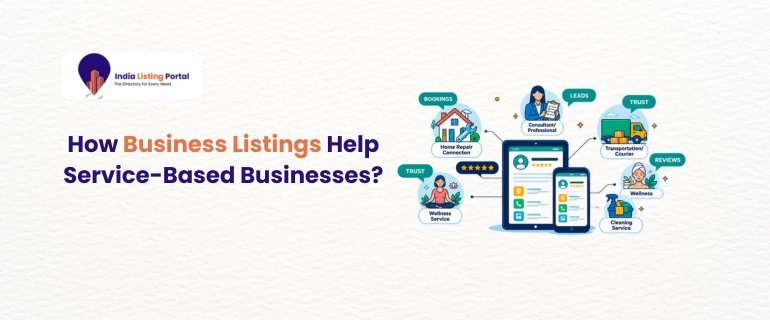
Why Business Listings for Service-Based Businesses Matter
Whether you are a plumbing company, a salon, or a consultancy, potential customers are searching the web before they even call. Business Listings for Service-based businesses are one of the easiest ways to get found right now. Unlike retail businesses with products to photograph, service businesses offer services, which are harder to capture on a website. A well-maintained listing gives customers the proof they need: your address, hours, reviews, and services in one place. This step-by-step guide explains how Business Listings can help service businesses grow and what to focus on first. For a deeper dive, check out our ultimate guide to business listing portals.
Key Takeaways
-
Listings are one way to build trust signals, which are more important to service businesses than product photos.
-
When pages appear in all the directories, they tend to rank higher in local search results.
-
Reviews that are gathered from listings affect purchasing decisions more than anything else.
-
Real leads cost if a single wrong or missing phone number is used.
-
Listings work alongside your website; they don't replace it
Business Listings Explained: What They Actually Do
A business listing is a profile of your business, which appears on a search engine, map, or directory, such as Google Business Profile, Bing Places, Justdial, or a specific directory. Each includes your Name, Address, Phone number (NAP), hours, categories, and a way to leave a review. Listings can be a service business's first real touchpoint. Someone searching "electrician near me" doesn't scan an entire site before choosing who to call.
Local SEO: How Listings Push You Up the Rankings
Listings are a trust check for search engines. If they have the same name, address, and phone number in dozens of directories, Google is more likely to believe your business is real and worth displaying. Inconsistencies increase uncertainty, and uncertainty costs ranking.
This matters more for service providers, since local search is driven by intent-based, local queries. Almost 98% of consumers search online for local businesses, up from 90% in 2019, and nearly half of all Google searches have local intent. When your listings vary in content, you're missing a lot of that demand. Our post on how local business listings improve local SEO rankings covers this in more depth.
A few practical steps that move the needle on Local SEO:
-
Claim and verify your Google Business Profile first, then add the other directories.
-
Maintain uniformity in NAP usage, including abbreviations such as "St." versus "Street.
-
Choose the most precise main category and update hours as soon as possible around holidays!
Online Visibility: Being Found Where Customers Already Are
Ranking well only matters if it puts you where customers are looking-and that's not just Google. While driving, service-seekers check Google Maps, browse industry directories while comparing quotes, and increasingly rely on AI assistants for recommendations. Business Listings for Service-Based Businesses takes you to all these locations at once, not on one channel. There's also a compounding payoff: businesses with consistent NAP information get an estimated 70% more calls than businesses with inconsistent NAP information. It's phones ringing and not rankings.
Building Trust Before the First Conversation
In a service business, the service is intangible; customers can't inspect it before buying. This is where trust signals have the most impact, and they live on listings: star ratings, number of reviews, and response rate.
Reviews do heavy lifting here. 99% of consumers read online reviews before buying, and 92% of them read reviews of local businesses before their first visit. For a service company with no brick-and-mortar location, that review area is typically the only “proof of work” a stranger sees before calling. A complete profile also provides answers to small questions in the beginning, service areas, response time, payment methods, and so on; thus, the first real conversation begins further along. See our guide on creating a perfect business listing profile for specifics.
Common Listing Mistakes That Quietly Cost Leads
Most service businesses do NOT lose leads because they are not listed; they lose leads because their listing is incomplete or outdated. A survey of 100 home service companies found that 85% of listings contained incorrect or missing information.
|
Mistake |
Why it hurts |
|
Different phone numbers across directories |
Confuses search engines and customers |
|
No service area or category listed |
Excludes you from relevant searches |
|
Ignored reviews, good or bad |
Signals an inactive, unmanaged business |
The fixes often take only a few hours, rarely require a redesign, and deliver results faster than most other local marketing. See our full rundown of common business listing mistakes.
Free vs. Paid Listings: Where Service Businesses Should Start
The best place to start is with free listings on Google Business Profile, Bing Places, and general directories, which make up most of what gets people to notice you. Paid listings on more expensive sites can help later, but they should be built on a strong free base, not a paid one. See our comparison of free vs. paid business listings.
Conclusion
Business Listings for Service-Based Businesses are no small thing; they're one of the most important factors influencing whether a nearby customer picks up the phone. Accurate listings lead to better Local SEO Rankings, Extended Online Visibility, and Greater Trust a Service Business Needs Before the First Conversation. Businesses that maintain and regularly update their listings are more likely to do better than businesses that set them up and forget about them. Start with the basics: a claimed Google Business Profile, consistent NAP details, and a handful of well-chosen directories.
FAQs
Q1. Does it work for a service business more than a product business?
Yes, since service businesses lack a physical product to showcase online. Listings substitute for that with reviews and trust signals.
Q2. How many business directories should a small service business list on?
Start with Google Business Profile and a couple of key general directories, then add a couple of niche directories for your industry or city.
Q3. How long does it take for business listings to improve local SEO rankings?
After a listing is fully optimized, most businesses will start to see movement in 4-8 weeks or less, depending on competition in the area.
Ready to put your business in front of local customers who are already searching? Add your listing on India Listing Portal, or get in touch if you have questions about setting up your profile.